Manchester City’s New Era Begins: What Comes Next?


Manchester City began the 2026/27 Premier League season knowing that the opening match would carry more significance than the usual first-weekend fixture. For the first time in more than a decade, the club entered a league campaign without Pep Guardiola in charge, with Enzo Maresca taking responsibility for one of the most demanding succession jobs in modern football.
The result offered an encouraging start. City recovered to beat Bournemouth 2-1, with Josko Gvardiol scoring a late winner to give Maresca victory in his first Premier League match as Manchester City manager. It was dramatic rather than comfortable, and that probably made it a more useful introduction to the challenge ahead.
The temptation after a first match is always to make immediate conclusions. A victory can suddenly become evidence that everything is working, while a defeat can create unnecessary doubts about a project that has barely begun. Manchester City should avoid both extremes. The opening weekend provided some positive signs, but the bigger questions surrounding the club remain unanswered.
This is not simply a new manager taking over an established team. Manchester City are attempting to move from one of the most successful periods in English football into a different era, while simultaneously adapting to major changes within the squad. The 2026/27 season may therefore be remembered less for the opening result and more for how quickly Maresca can establish a recognisable version of Manchester City that belongs to him.
The Guardiola shadow cannot simply be ignored

Every manager who replaces a successful predecessor faces comparisons, but the scale of Guardiola's influence makes Maresca's situation particularly unusual.
Guardiola did not leave behind a team defined by one tactical system that could simply be copied. Over the course of his time at City, the team evolved repeatedly. Full-backs became midfielders, centre-backs moved into advanced positions and different versions of the midfield were built around the players available.
The consistency came from the principles rather than one fixed formation.
That creates both an opportunity and a problem for Maresca. He understands many of the ideas that shaped City's recent identity, but simply reproducing Guardiola's football would not necessarily be enough. The squad has changed, the Premier League has changed and several of the players who defined the previous era are no longer central to the project.
Manchester City are also entering the season after significant changes across the Premier League. Arsenal began the campaign as defending champions, while City and Liverpool are both dealing with major transitions of their own.
Maresca therefore has to manage expectations while building something that supporters can recognise as a continuation of City's ambition without turning every match into a comparison with the past.
The midfield will determine how quickly City evolve
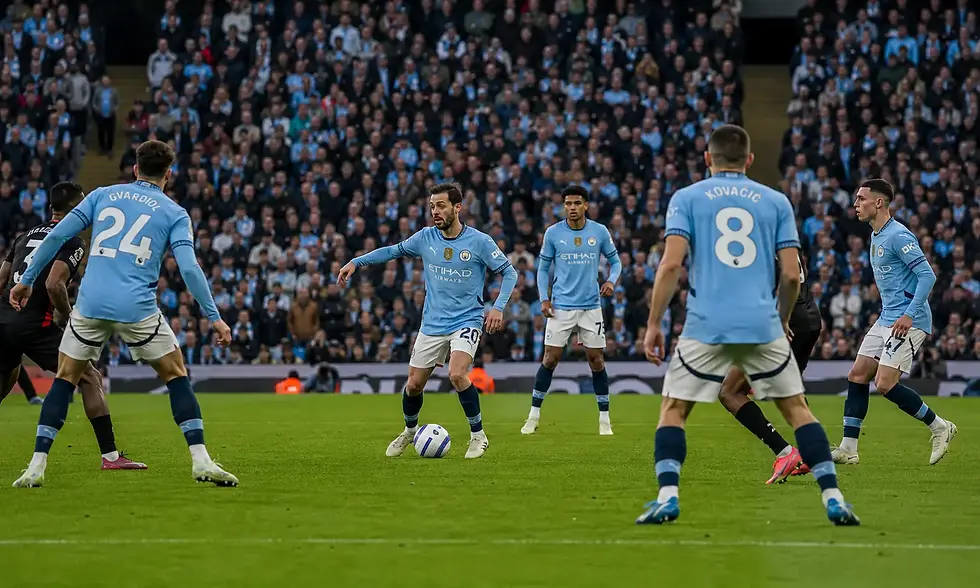
The most important changes may be taking place away from the attacking headlines.
For years, City's ability to control matches depended heavily on the structure of their midfield. The departure of Rodri, one of the defining players of the Guardiola era, means that Maresca cannot simply recreate the same system and expect the same results.
The midfield now has to develop a new identity.
That does not necessarily mean finding one player capable of doing everything Rodri did. In fact, trying to identify a direct replacement could be the wrong approach. City may instead need to distribute those responsibilities across several players, with different midfielders contributing to progression, defensive protection and control.
This is where the next few months will become particularly interesting.
Manchester City's best teams have often been difficult to play against because they controlled what happened after losing possession as effectively as they controlled the ball. If the new midfield can maintain that balance, Maresca will have a foundation on which to build. If it cannot, the transition could become considerably more difficult, particularly against opponents capable of exploiting space quickly.
Erling Haaland is now one of the constants
While the structure around him changes, Erling Haaland remains one of the clearest links between Manchester City's recent success and their future.
The Norwegian has already established himself as one of the Premier League's most prolific forwards and remains central to the club's long-term plans. His current contract runs until 2034, giving City a player around whom they can continue to build even as other areas of the squad evolve.
His importance may actually increase during this transition.
A team in tactical development can often become less predictable, but that does not always mean it becomes less dangerous. If Manchester City become more direct or experience more transitional moments than they did at their most possession-dominant, Haaland could benefit from receiving the ball in situations where defenders have more space to cover.
At the same time, City will still face the familiar challenge of breaking down deep defensive blocks. Haaland's relationship with the midfielders, wide players and attacking creators will therefore remain central to Maresca's plans.
The question is not whether Haaland will score goals. His record suggests that is the safest assumption anyone can make. The more interesting issue is how the structure around him changes and whether he becomes an even more complete attacking reference point for the new Manchester City.
One victory does not answer the biggest questions
The late win against Bournemouth was an ideal result for Maresca's first Premier League match, but the performance also underlined why the season will require patience.
Manchester City are not entering 2026/27 with a finished project.
They have a new manager, a changing midfield and the challenge of adapting after one of the most successful managerial periods in the club's history. Those circumstances make short-term inconsistency entirely possible, particularly during the opening months of the season.
The Premier League itself also appears unusually competitive. Arsenal are defending the title, while several major clubs have entered the season with new managers and significantly altered squads.
That environment leaves little room for a slow start.
Maresca needs to develop his team while continuing to collect points, and that balance will define the early stages of his Manchester City career. Supporters may be willing to accept that a transition takes time, but City's standards remain exceptionally high.
The identity of the new Manchester City is still being written
Perhaps the most important thing to watch over the coming months will not be the league position alone.
It will be the development of City's identity.
Will Maresca's team dominate possession in the familiar Guardiola style, or will it become more aggressive and vertical? Will the midfield be built around one controlling presence, or will responsibility be shared more evenly? How much freedom will Haaland and the attacking players have within the new structure?
Those questions cannot be answered after one match.
What the Bournemouth victory did provide was a positive starting point. A late winner on the opening weekend will not define Maresca's Manchester City career, but it gives him something useful: time to continue building without immediately dealing with the pressure of a defeat.
The real challenge starts now.
Manchester City have spent years setting standards that most clubs would struggle to reach. The next stage is about discovering whether those standards can survive a change that affects both the dugout and the pitch.
Maresca does not need to recreate Guardiola's Manchester City. In many ways, trying to do so would be the wrong approach.
He needs to build the next version of it.
And after an encouraging, if imperfect, start to the Premier League season, that process is officially underway.




Comments