10 Cristiano Ronaldo Records and Achievements That Define His Career

Updated: Sep 22

Cristiano Ronaldo’s career has reached a point where individual records tell only part of the story. His numbers stretch across more than two decades, several countries, different tactical eras and almost every major stage available to an elite European footballer.
Some of those achievements came during his extraordinary years with Real Madrid. Others were built with Manchester United, Juventus, Al-Nassr and Portugal. His international career has produced another collection of records, while his longevity has allowed him to keep adding goals and appearances long after most players from his generation retired.
That breadth is what makes Ronaldo’s statistical legacy unusual. He did not dominate only one competition or spend his entire peak in one environment. His game evolved from an explosive winger into a prolific forward and eventually a veteran goalscorer increasingly dependent on movement, anticipation and finishing.
Rather than separating similar records into individual entries, these are 10 broader achievements that best demonstrate the scale of Cristiano Ronaldo’s career.
10. Real Madrid’s All-Time Leading Goalscorer

Becoming the leading goalscorer in Real Madrid history would be an extraordinary achievement on its own. Ronaldo managed it while scoring more goals than the number of competitive matches he played for the club.
Real Madrid officially credit Ronaldo with 451 goals in 438 competitive appearances between 2009 and 2018. His goals included 312 in La Liga and 105 in the Champions League, with the remainder spread across domestic and international cup competitions.
The numbers are even more remarkable when placed within Madrid’s history. This is a club represented by Alfredo Di Stéfano, Ferenc Puskás, Raúl, Karim Benzema and many other legendary forwards. Ronaldo arrived in that environment and eventually moved above all of them in the club’s scoring records.
His transformation during those nine seasons was also significant. The Ronaldo who arrived from Manchester United still possessed many of the characteristics of an attacking winger. Over time, his movement became more direct, his positioning increasingly focused on goalscoring areas and his efficiency in the penalty box became central to Madrid’s attack.
The result was one of the most productive periods any player has produced for a major European club.
9. His Extraordinary European Championship Record

Ronaldo’s European Championship career deserves to be considered as a collection of achievements rather than reduced to one statistic.
He holds the records for most EURO final tournaments played, most EURO finals appearances and most EURO finals goals. UEFA credits him with six tournaments, 30 appearances and 14 goals at the finals, while his overall EURO tally including qualification stands at 55 goals.
The longevity behind those numbers is remarkable. Ronaldo first appeared at EURO 2004 as a young Manchester United player when Portugal hosted the tournament. Twelve years later, he captained his country as they defeated France to win EURO 2016.
That victory was particularly important to Ronaldo’s career because international success had remained one of the few major gaps in his honours. Portugal had produced outstanding generations before, but had never won a senior men's major tournament.
Ronaldo’s EURO record therefore represents much more than longevity. It connects the beginning of his international career with the period in which Portugal finally became European champions.
8. Record-Breaking Success Across Clubs, Countries and Eras

One of the most impressive aspects of Ronaldo’s career is not simply how many goals he has scored, but how often he has been able to reproduce them after changing his surroundings.
His senior journey began at Sporting CP before Manchester United transformed him from an exciting winger into one of the world’s best players. He then moved to Real Madrid in 2009 and produced the most prolific period of his career, eventually becoming the club’s record goalscorer.
Moving to Juventus at 33 presented a very different challenge. Serie A offered another tactical environment, yet Ronaldo remained a prolific scorer. His later move to Al-Nassr extended the journey into another country and another stage of his career.
Those leagues should not be treated as though they offered identical competitive environments. They did not. Ronaldo’s achievements in the Premier League, La Liga, Serie A and Saudi football need to be understood within their individual contexts.
What stands out is his ability to modify his game as those surroundings changed.
The young Manchester United winger, the devastating Real Madrid forward, the experienced Juventus goalscorer and the veteran playing for Al-Nassr were not exactly the same footballer. Ronaldo gradually relied less on carrying the ball over long distances and increasingly on movement, anticipation, aerial ability and finishing.
His goals followed him across countries, managers, tactical systems and different stages of his own physical development. That adaptability is one of the central reasons his career has lasted so long.
7. The Cristiano Ronaldo Champions League Record Collection
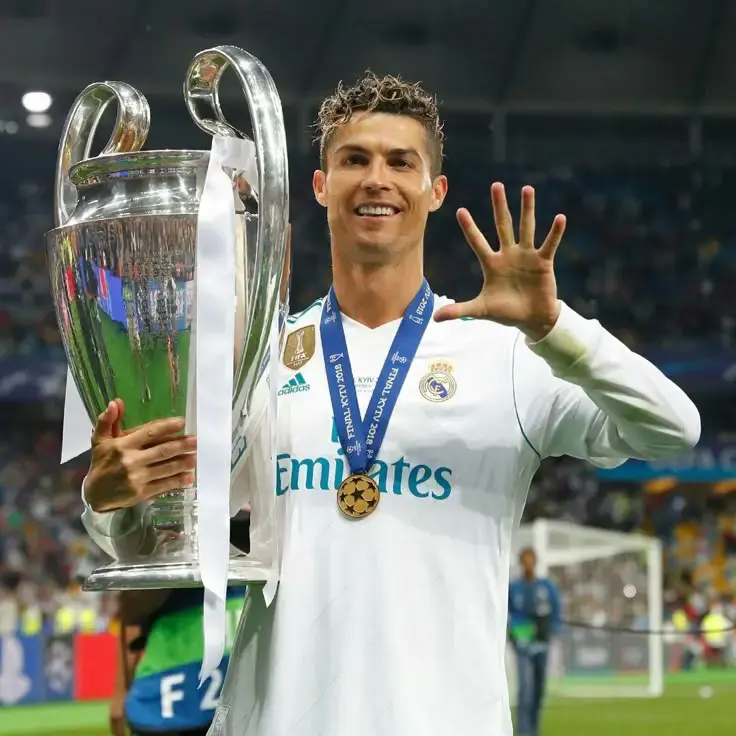
If one competition is most closely associated with Ronaldo’s club career, it is the Champions League.
Instead of isolating each record, it makes more sense to consider the entire collection. Ronaldo finished his Champions League career with a record 140 goals in 183 appearances. He also holds the records for 17 goals in a single campaign and 67 knockout-stage goals. He finished as the competition’s leading scorer seven times and remains the only player to have scored in three Champions League finals.
Then there are the trophies.
Ronaldo won the Champions League five times, first with Manchester United in 2008 and then four times with Real Madrid. His Madrid years coincided with one of the greatest periods of European dominance in the modern game, including three consecutive titles between 2016 and 2018.
What makes the record collection particularly impressive is how Ronaldo’s relationship with the competition developed. He did not begin his Champions League career as a prolific central goalscorer. His first goals in the competition proper did not arrive until 2007.
By the time he left European football, however, he had become the competition’s record scorer and appearance-maker.
Future players may surpass individual parts of the collection. Expanded formats provide more matches, while players such as Kylian Mbappé and Erling Haaland have accumulated goals rapidly.
Matching the entire body of work will be considerably more difficult.
6. The First Male Player to Score at Six World Cups
Ronaldo’s World Cup career provides another demonstration of his extraordinary longevity.
He became the first male player to score at six different World Cup final tournaments, finding the net in 2006, 2010, 2014, 2018, 2022 and 2026.
The achievement becomes clearer when viewed through the generations surrounding him.
At the 2006 World Cup, Ronaldo was a young attacker playing alongside established Portuguese stars such as Luís Figo and Deco. Twenty years later, he was still representing Portugal at the same tournament while surrounded by an entirely different generation.
Very few footballers remain international players for that length of time. Fewer still remain capable of scoring.
Ronaldo’s World Cup career has contained spectacular individual moments as well as disappointments, but this particular record captures something broader than tournament success. It illustrates just how long he remained relevant at international level.
5. Most Goals in Men’s International Football

Ronaldo holds one of the most significant individual records in international football.
UEFA recorded him at a world-record 146 goals for Portugal in 233 appearances in its July 2026 update. He surpassed Iran’s Ali Daei to become the leading scorer in men’s international football in 2021 and has continued extending the record since.
Those goals have been accumulated across European Championships, World Cups, Nations League matches, qualifying campaigns and friendlies.
The length of the scoring run is equally impressive. UEFA notes that after failing to score in his first two Portugal appearances in 2003, Ronaldo scored for his country in 23 consecutive calendar years through 2026, another world record.
International football presents different challenges from club football. Players have considerably less time together, tactical structures can change between international windows and major tournaments arrive only periodically.
Ronaldo nevertheless continued scoring across multiple generations of the Portugal team.
His international goal record is therefore as much a longevity achievement as a goalscoring one.
4. Most Appearances in Men’s International Football
Goals are the most visible part of Ronaldo’s international career, but his appearance record is arguably just as difficult to reproduce.
UEFA listed Ronaldo at 233 international appearances in July 2026, making him the most-capped male international footballer. He became the first player in men’s international football to reach 200 appearances when Portugal faced Iceland in June 2023.
The circumstances of that 200th appearance were fitting. Ronaldo scored an 89th-minute winner.
Accumulating more than 200 international appearances requires an unusual combination of talent, durability and continued selection. Unlike club football, where a player can potentially make more than 50 appearances in one season, international fixtures are limited.
Ronaldo made his Portugal debut in 2003 and remained part of the national team into his forties.
During that period, Portugal changed from a talented European nation still searching for its first major senior trophy into European champions and Nations League winners.
Ronaldo was present throughout that transformation.
3. More Than Two Decades of International Goals

Ronaldo’s 146 Portugal goals understandably receive most of the attention, but another record reveals the extraordinary timespan behind them.
After making his international debut in 2003, Ronaldo began scoring for Portugal in 2004 and subsequently registered an international goal in 23 consecutive calendar years through 2026. UEFA identifies it as a world record.
Maintaining a scoring run across that length of time requires more than simply avoiding retirement.
A player must continue being selected, remain physically capable of competing internationally and still offer enough attacking value to score against international opposition.
Ronaldo achieved that while his own role changed dramatically.
The player scoring for Portugal during the mid-2000s was a quick, technically adventurous winger. The veteran Ronaldo relied much more heavily on penalty-box positioning, movement and finishing.
That evolution is important because longevity in football rarely comes from remaining exactly the same player. It usually requires adapting before physical decline makes adaptation impossible.
Ronaldo repeatedly managed that transition.
2. Five Ballon d’Or Awards Across a Decade of Elite Football

Not every defining achievement in Ronaldo’s career needs to be presented as a record.
His five Ballon d’Or awards provide another way of understanding the length and quality of his peak. Ronaldo won the award in 2008, 2013, 2014, 2016 and 2017.
The first came at Manchester United after he had developed from a gifted winger into one of football’s most decisive attacking players. The later awards came during his Real Madrid years, when his game had evolved and his goalscoring reached extraordinary levels.
The spread between those victories matters.
Football careers often contain a relatively narrow peak during which a player competes for the sport’s biggest individual honours. Ronaldo remained at that level across different stages of his career while competing directly with Lionel Messi during an era in which the pair dominated the award.
The Ballon d’Or is ultimately decided by voting rather than an objective statistical formula, so it belongs in a different category from Ronaldo’s goalscoring records.
Even so, five victories demonstrate how long he remained at the centre of elite football.
1. The Pursuit of 1,000 Career Goals

The final chapter of Ronaldo’s record-breaking career is still being written.
After moving beyond 900 official senior goals, attention naturally shifted toward a number that once appeared almost unreachable: 1,000 career goals.
The exact live total can differ slightly between statistical databases depending on their classification of particular competitions and matches, which means any running number should be attached to a specific source and date. The broader achievement does not depend on those small discrepancies.
Ronaldo has accumulated his goals for Sporting CP, Manchester United, Real Madrid, Juventus, Al-Nassr and Portugal. They span domestic leagues, cups, European competitions, international qualifiers and major tournaments.
That distribution is what makes the pursuit of 1,000 particularly fascinating.
Ronaldo did not simply find one successful environment and remain there. His career moved through Portugal, England, Spain, Italy and Saudi Arabia, while his international career ran alongside all of them.
His physical profile also changed enormously during that period. The explosive acceleration and dribbling that defined his early years could not last forever. Ronaldo compensated by becoming increasingly efficient around goal, improving his movement and using his aerial ability and anticipation to remain dangerous.
Whether he eventually reaches 1,000 will depend on how long he continues playing and how frequently he scores during the final stage of his career.
Reaching the milestone would be historic, but finishing short of it would not fundamentally change the scale of what came before.
The remarkable achievement is that 1,000 has become a realistic conversation at all.
What Makes Cristiano Ronaldo’s Records So Difficult to Break?
Individual records inevitably fall.
The Champions League has changed its format, creating more matches for future generations. Improvements in sports science may allow more players to extend their careers. Young forwards such as Mbappé and Haaland have also demonstrated that historic scoring lists can be climbed remarkably quickly.
The challenge is reproducing Ronaldo’s achievements collectively.
A player attempting to match his career would need to become elite at a young age, score consistently for some of the world’s biggest clubs, remain productive after changing leagues, perform in the Champions League, sustain an international career for more than two decades and adapt as his physical abilities changed.
Breaking one Ronaldo record is very different from replicating the career that produced all of them.
A future forward might surpass his Champions League total without approaching his international records. Another player could eventually score more international goals without matching his achievements at Real Madrid.
That distinction is important when evaluating Ronaldo’s statistical legacy.
Cristiano Ronaldo’s Records Tell a Bigger Story
Statistics cannot settle every argument about football greatness. Comparing players across generations requires consideration of teammates, opponents, tactics, competition formats and the different environments in which they played.
Ronaldo’s records do establish something more straightforward: the extraordinary scale and duration of his production.
He became Real Madrid’s record goalscorer. He built an unparalleled collection of Champions League records. He became the leading goalscorer and appearance-maker in men’s international football. He established European Championship records, scored across six World Cups and continued finding the net for Portugal for more than two decades.
Along the way, he succeeded in different countries and repeatedly altered his game to extend his career.
Some of his records will eventually disappear. That is part of sport, and future generations should be expected to challenge numbers that once appeared unreachable.
The more difficult achievement may be reproducing the career connecting all of them. Ronaldo’s legacy is not built around one extraordinary season or one statistical record, but around maintaining an elite level of production for a period few footballers have ever matched.


Comments