The Champions League Is Returning to Camp Nou. Why the 2029 Final Means More for Barcelona?

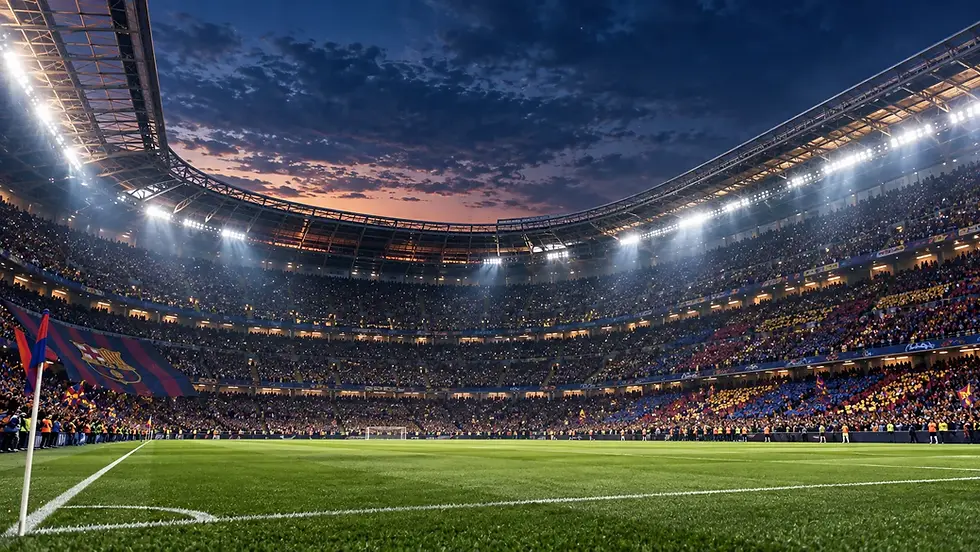
Some stadiums host Champions League matches, while others become inseparable from the history of the competition itself. Camp Nou belongs firmly in the second category. Barcelona's home has witnessed generations of extraordinary footballers, unforgettable European nights and some of the defining moments in the club's history, but it has been more than a quarter of a century since European football's biggest club match was staged there.
That wait now has an end date. UEFA has confirmed that Barcelona will host the 2029 Champions League final at Camp Nou, with Munich's Allianz Arena selected for the 2028 edition. For Barcelona, the announcement represents considerably more than another major sporting event arriving in the city. It places the rebuilt Camp Nou back at the centre of European football and gives the club a symbolic destination for the next phase of its history.
The stadium's previous Champions League final came in 1999, when Manchester United produced one of the competition's most famous comebacks against Bayern Munich. By the time Europe's two finalists walk onto the pitch there in 2029, thirty years will have passed since that extraordinary night.
Much about Camp Nou will have changed by then, but its relationship with European football will remain immediately recognisable.
Camp Nou and the Champions League belong together

Barcelona's stadium has always carried a particular weight on European nights. The size of the ground, the steep walls of supporters surrounding the pitch and the history associated with the club have created an atmosphere that feels different when the Champions League anthem begins.
For Barcelona supporters, many of the club's greatest modern memories are connected to those nights. Lionel Messi produced some of the finest football of his career there, while Xavi, Andrés Iniesta, Ronaldinho, Neymar, Luis Suárez and numerous other stars contributed to an era in which Barcelona became one of the defining European clubs of the 21st century.
There were also painful nights, because Champions League history is rarely built exclusively through victories. European football repeatedly tested Barcelona's identity, exposing weaknesses during difficult periods while producing extraordinary performances when the team was at its strongest.
That emotional history gives the 2029 announcement significance beyond the logistical decision of choosing a host city.
UEFA could stage the final in many modern stadiums capable of providing the infrastructure required for an event of this scale. Choosing Camp Nou represents a return to one of European football's most recognisable stages at a moment when the stadium itself is being reinvented.
The new Camp Nou is central to Barcelona's future
Barcelona began the major redevelopment of Camp Nou in 2023 as part of the broader transformation of the club's facilities. Work on the stadium remains ongoing, and UEFA's decision to award Barcelona the 2029 final represents an important endorsement of the project's ambitions.
The redevelopment is important because Barcelona's future cannot be separated from the economics of its stadium. Modern football grounds are no longer simply places where supporters arrive every second weekend to watch a match. Europe's largest clubs increasingly rely on their stadiums as year-round commercial assets capable of generating revenue through hospitality, sponsorship, entertainment and major international events.
Camp Nou's transformation therefore has sporting consequences as well as architectural ones. Barcelona have spent recent years attempting to remain competitive at the highest level while dealing with significant financial constraints. A modernised stadium capable of generating substantially greater revenue is an important part of creating a more sustainable foundation for the club.
Hosting a Champions League final gives that project an international showcase.
By 2029, UEFA will effectively be handing Barcelona the biggest annual club football event in the world and asking the rebuilt stadium to provide its stage.
The memories of 1999 will inevitably return

The last Champions League final played at Camp Nou remains one of the most famous matches in the competition's history.
Bayern Munich appeared to be heading toward the European title after Mario Basler's early goal gave them the lead against Manchester United. With the match entering stoppage time, Sir Alex Ferguson's team were still behind and Bayern were preparing to celebrate.
Then the entire contest changed.
Teddy Sheringham equalised before Ole Gunnar Solskjær scored the winner moments later, completing an extraordinary comeback and securing Manchester United's historic treble. The scenes inside Camp Nou became part of Champions League folklore, ensuring that the stadium's relationship with the final would remain memorable even during the long period before the competition eventually returned.
When the final comes back in 2029, the comparison between the old and new stadium will be impossible to ignore. Football itself will have changed enormously across those thirty years, from tactics and technology to broadcasting and the financial scale of the competition.
The fundamental attraction of the Champions League final, however, will remain familiar. Two teams, one stadium and ninety minutes with the potential to define careers.
Barcelona will dream about being there themselves

There is another possibility that will inevitably occupy the imagination of Barcelona supporters over the next three seasons: what if Barcelona actually reach the 2029 final?
Hosting the Champions League final does not automatically provide the designated stadium's club with any sporting advantage, and reaching the final three years from now would require navigating an enormous number of variables that cannot reasonably be predicted today. Squads change, managers leave, young players develop and European football's balance of power can shift surprisingly quickly.
Even so, the possibility creates a compelling long-term storyline.
Barcelona currently possess a generation of players who could be approaching their peak years by 2029. Lamine Yamal is the most obvious example, but the wider significance is that several members of Barcelona's young core could mature together as the rebuilt stadium establishes its own identity.
For supporters who spent years watching Messi's generation dominate European football, the idea of another Barcelona side competing for the Champions League inside a transformed Camp Nou would carry enormous emotional weight.
It should remain a dream rather than an expectation, but football is rarely short of dreams when a date like this appears on the calendar.
Munich will get another European night first
Before the Champions League reaches Barcelona, the 2028 final will be staged at Munich's Allianz Arena.
It will be the third time the Munich venue has hosted the final. Chelsea defeated Bayern Munich there on penalties in 2012, producing one of the most painful nights in Bayern's modern history, before Paris Saint-Germain won their first Champions League title at the stadium in 2025.
The Allianz Arena already possesses almost everything UEFA wants from a modern final venue: established infrastructure, experience hosting major international events and one of Europe's most recognisable stadium designs.
Munich and Barcelona therefore represent two slightly different choices. The 2028 final returns to an established modern venue with recent experience of staging the event, while the 2029 final will showcase one of football's great historic stadiums after a major transformation.
Both decisions reinforce an important element of the Champions League's appeal. The competition continually evolves, but its biggest nights remain deeply connected to Europe's great football cities.
Madrid comes before both of them
There is plenty of Champions League football to be played before anyone begins seriously thinking about 2028 or 2029.
The current 2026/27 campaign will conclude at Atlético Madrid's Estadio Metropolitano on June 5, 2027. UEFA's latest announcement therefore creates a sequence in which Madrid hosts the current season's final before Munich takes over in 2028 and Barcelona follows in 2029.
That sequence also reflects how important stadiums have become to the identity of the Champions League.
Supporters remember who won the competition, but they frequently remember where it happened as well. Wembley, San Siro, the Bernabéu, Camp Nou and other great European grounds become part of the imagery surrounding particular finals.
A stadium provides the backdrop against which the competition creates its defining photographs: the captain lifting the trophy, supporters celebrating behind the goal and players sitting exhausted on the pitch after defeat.
In 2029, Camp Nou will provide that backdrop again.
A new stadium carrying an old European history

Barcelona's redevelopment project is designed to create a stadium suited to the future, but the greatest strength of Camp Nou has always been the history that already exists within it.
Modern facilities can be built almost anywhere. History cannot.
The players who have walked onto that pitch, the European matches played there and the generations of supporters who have filled its stands give Camp Nou an identity that architecture alone cannot reproduce. The challenge for Barcelona's redevelopment has always been to modernise the stadium without losing the sense that this remains one of football's great historic homes.
Hosting the 2029 Champions League final will become one of the clearest tests of whether that balance has been achieved.
Thirty years after Manchester United's extraordinary comeback against Bayern Munich, another two teams will arrive in Barcelona with the European Cup waiting at the end of the night. The stadium surrounding them will look very different from the one that witnessed the 1999 final, but the occasion will carry the same possibility that has always made the Champions League compelling.
Someone will leave Camp Nou having created a piece of football history. This time, they will do it inside a stadium beginning a new chapter of its own.


Comments